2002: Diary of a Season
Sunday, September 29, Fenway Park, Section 32Red Sox 11, Devil Rays 8
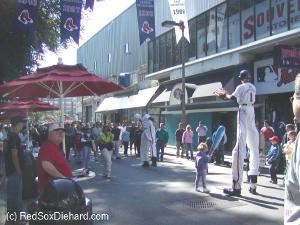 This was the final game of the season. It was also my brother's birthday, and I was going to the game with him and my parents. When I go with them, I don't have to take the T; we all meet at a relative's house outside Boston and drive in together. We parked on Lansdowne Street behind the Green Monster, and as we sat in the car waiting for the gates to open, we wound up chatting with one of the Italian sausage vendors. He was saying that he used to be stationed around the corner on Yawkey Way, but when that street became part of the park on game days, he had to move. I sympathized, telling him I thought the new Yawkey Way was just a gimmick, and that it was the vendors outside the park who gave Fenway the atmosphere that all the new ballparks were trying to copy. He asked who we thought would win today (the Red Sox of course) and then tried to make a bet with my father on the score or the margin of victory. This was the final game of the season. It was also my brother's birthday, and I was going to the game with him and my parents. When I go with them, I don't have to take the T; we all meet at a relative's house outside Boston and drive in together. We parked on Lansdowne Street behind the Green Monster, and as we sat in the car waiting for the gates to open, we wound up chatting with one of the Italian sausage vendors. He was saying that he used to be stationed around the corner on Yawkey Way, but when that street became part of the park on game days, he had to move. I sympathized, telling him I thought the new Yawkey Way was just a gimmick, and that it was the vendors outside the park who gave Fenway the atmosphere that all the new ballparks were trying to copy. He asked who we thought would win today (the Red Sox of course) and then tried to make a bet with my father on the score or the margin of victory.
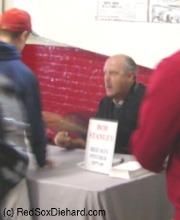
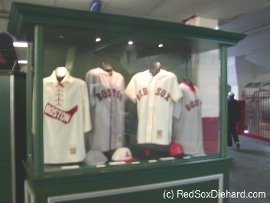 When the gates opened, we went in and walked around to Yawkey Way, since my family had not been to any games since it had changed. What I did enjoy, that I hadn't noticed before, was inside Fenway in the vicinity of Gate A. There was a large wall display featuring the other ballparks in Boston (Huntington Avenue Gounds, Braves Field, and others) with pictures and historical information. There was also a display of Red Sox uniforms through the years. This felt like being at the Hall of Fame, and has the potential to be a really nice feature of Fenway. With all the activity out on the street, the concourses have a lot more room. I'd love to see the plaques from the Red Sox Hall of Fame moved downstairs from their current place in a club room for season ticket holders, and made accessible to all the fans. Also inside near Gate A was a table where former Red Sox pitcher Bob Stanley was signing autographs. I found myself thinking this wasn't so bad after all! If the Red Sox could keep Yawkey Way from being tacky and commercial, and focus instead on the history and tradition of the team, I might even start to like it. When the gates opened, we went in and walked around to Yawkey Way, since my family had not been to any games since it had changed. What I did enjoy, that I hadn't noticed before, was inside Fenway in the vicinity of Gate A. There was a large wall display featuring the other ballparks in Boston (Huntington Avenue Gounds, Braves Field, and others) with pictures and historical information. There was also a display of Red Sox uniforms through the years. This felt like being at the Hall of Fame, and has the potential to be a really nice feature of Fenway. With all the activity out on the street, the concourses have a lot more room. I'd love to see the plaques from the Red Sox Hall of Fame moved downstairs from their current place in a club room for season ticket holders, and made accessible to all the fans. Also inside near Gate A was a table where former Red Sox pitcher Bob Stanley was signing autographs. I found myself thinking this wasn't so bad after all! If the Red Sox could keep Yawkey Way from being tacky and commercial, and focus instead on the history and tradition of the team, I might even start to like it.
 Before the game, there was a ceremony honoring Rickey Henderson, in which he was presented with a car. He had not formally announced his retrirement, but after 24 seasons in the majors, this was likely his last game. I thought it was a bit overboard, because while he is certain to be a first-ballot Hall-of-Famer, he had only played one season - and sparingly at that - with the Red Sox. (A co-worker of mine quipped the next day, "If Rickey got a car, what are they going to give Nomar when he retires, a space shuttle?") The game featured Casey Fossum against Delvin James, who had pitched against the Red Sox in the Derek Lowe no-hitter earlier in the year. I was horrified when the lineups were announced and Manny Ramirez's name did not appear. He had a .349 average and a 9-point lead in the race for the batting title, and I thought it poor sportsmanship to leave the potential batting champion out of the lineup, especially with all the hype this summer about Ted Williams' 1941 batting title. Manager Joe Cronin had offered to let him sit out the final day and preserve his .400 average, but he played, went 6-8 in the doubleheader, and finished at .406. I knew Ted would not approve of Grady Little's choice to sit Manny out today. Before the game, there was a ceremony honoring Rickey Henderson, in which he was presented with a car. He had not formally announced his retrirement, but after 24 seasons in the majors, this was likely his last game. I thought it was a bit overboard, because while he is certain to be a first-ballot Hall-of-Famer, he had only played one season - and sparingly at that - with the Red Sox. (A co-worker of mine quipped the next day, "If Rickey got a car, what are they going to give Nomar when he retires, a space shuttle?") The game featured Casey Fossum against Delvin James, who had pitched against the Red Sox in the Derek Lowe no-hitter earlier in the year. I was horrified when the lineups were announced and Manny Ramirez's name did not appear. He had a .349 average and a 9-point lead in the race for the batting title, and I thought it poor sportsmanship to leave the potential batting champion out of the lineup, especially with all the hype this summer about Ted Williams' 1941 batting title. Manager Joe Cronin had offered to let him sit out the final day and preserve his .400 average, but he played, went 6-8 in the doubleheader, and finished at .406. I knew Ted would not approve of Grady Little's choice to sit Manny out today.
Surprisingly, the Devil Rays got on the board first, when doubles by Toby Hall and Ben Grieve plated a run in the second. The Sox scored twice in the second to take the lead, when Shea Hillenbrand and Trot Nixon doubled, and Jason Varitek singled. But in the fifth, Tampa got three more. Brent Abernathy scored on Carl Crawford's groundout, and Randy Winn followed with a two-run homer. Aubrey Huff was next, and Fossum's first pitch was inside, prompting the umpires to issue warnings to both teams. After warnings have been issued, if a pitcher hits a batter or even throws too far inside and it's deemed intentional, both he and the manager are supposed to be automatically ejected. Fossum struck Huff out to end the inning, but the Devil Rays led, 4-2.
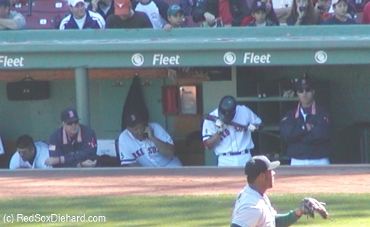
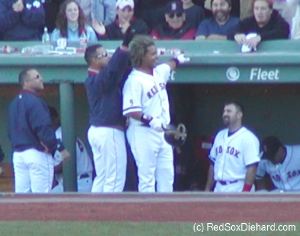
Jason Varitek, Grady Little, Tony Cloninger, Nomar
Garciaparra, and Mike Stanley in the dugout |
In the fifth, Shane Andrews replaced Johnny Damon, and led off with a double. After Benny Agbayani grounded out and Nomar Garciaparra walked, Cliff Floyd came up, representing the go-ahead run. I have nothing against Floyd, but this should have been Manny's spot, and we needed a couple of runs driven in. "Hey Grady, where's Manny?" I yelled. But I was happy that Floyd did knock Andrews in with a fielder's choice. Hillenbrand was up next, and James threw way inside, making Shea duck to avoid being hit. But he wasn't thrown out of the game! Everyone knows after warnings have been issued, the pitcher doesn't have to actually hit a batter to get thrown out, but anything in the vicinity of the head is enough. That's what happened to Pedro in the 2000 season, when he was ejected and suspended for throwing inside to - but not hitting - Cleveland's Einar Diaz after warnings had been issued. Somehow, James was permitted to stay in the game, and Hillenbrand hit a single to drive in Floyd, who had moved up on the wild pitch. Nixon followed with his third hit of the day, a double to drive in Hillenbrand, and the Red Sox were back on top, 5-4.
At that point Delvin James was replaced by Wilson Alvarez, who hit the very first batter he faced, Jason Varitek. He clearly should have been ejected immediately, but he was inexplicably allowed to stay in the game. "Throw him out!" everyone was shouting. Brian Daubach followed with a two-run double, making it 7-4 Sox, before Lou Merloni hit a fly ball to end the inning. Fossum gave up a couple of hits and another run in the sixth, and he was replaced by Frank Castillo, who gave up three more runs for an 8-7 Devil Rays lead. Alvarez started the sixth inning by hitting Shane Andrews - and again he was not ejected! This was really ridiculous, although it didn't entirely surprise me since two of the umpires were Tim Tschida and Rick Reed, who had each admitted to making costly bad calls against the Red Sox in the 1999 playoffs. But the Sox made the most of the inning, scoring two more runs and reclaiming the lead. (That hit-by-pitch was the 94th of the year by Tampa Bay pitchers, and broke the record of 93 set by the Red Sox in 2001.)
 Throughout the game, the Red Sox put congratulatory messages on the Jumbo-Tron between innings for their most productive players. We got to give nice ovations to Derek Lowe for his April 27th no-hitter, Manny Ramirez for his batting title (but come on, Grady, why wasn't he in the lineup?) and Pedro Martinez for his outstanding season. Getting to give a final cheer to players who weren't in the game today was a nice gesture, and helped bring some closure to a season that I didn't want to end. Throughout the game, the Red Sox put congratulatory messages on the Jumbo-Tron between innings for their most productive players. We got to give nice ovations to Derek Lowe for his April 27th no-hitter, Manny Ramirez for his batting title (but come on, Grady, why wasn't he in the lineup?) and Pedro Martinez for his outstanding season. Getting to give a final cheer to players who weren't in the game today was a nice gesture, and helped bring some closure to a season that I didn't want to end.
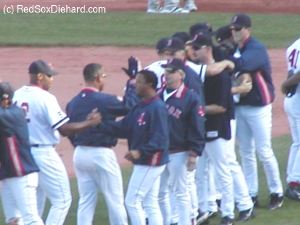
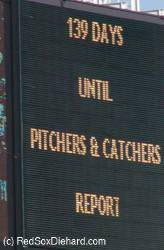
Varitek hit a homer to lead off the seventh. Manny finally got a chance to bat later that inning, with two outs and the bases loaded. He walked, driving in a run, and then was replaced by pinch-runner Rickey Henderson. Ugueth Urbina came in for the ninth, and got his 40th save of the season. When it was over, all the players came out onto the field to exchange hugs and high-fives. The Jumbo-Tron announced that the Red Sox set a new home attendance record in 2002, with 2,650,063. Then they displayed, "The Red Sox thank you for your support this season and look forward to seeing you Opening Day, April 11, 2003." Next came the words that would help sustain me through the long off-season: "139 days until pitchers and catchers report!" We didn't want to leave. Nomar came out to thank the fans, like he has at the end of every season. Finally, the players left the field, and we headed out to the car.
As we were halfway pulled out of our parking space (and probably blocking part of Lansdowne Street) the sausage vendor we had talked to before the game came over and leaned in the window of the car. "Who won?" he asked. "What was the score?" He chatted a little while longer, before we finally wished him luck and drove off. "Only at Fenway!" I thought.
|

 Feeding the Green Monster, by Rob Neyer.