|
Fenway Park History
|
Quick Photo Links | |
The 1912 World Series
Pictures from Fenway's first season, from the Library of Congress.
May 9, 1987
Fenway Park at the first game I went to, before the .406 Club was built.
Fenway Park 2003
Changes for the 2003 season, including the Green Monster seats and the Big Concourse.
Fenway Park 2004
2004 changes, including the right field roof seats.
|
For the first eleven years, Boston's American League team played at the Huntington Avenue Grounds, now the site of Northeastern University. A statue of Cy Young marks the site of the pitcher's mound. (The statue and a home plate-shaped marker can be found on the NU campus off Forsyth St. near Churchill Hall, not far from the Ruggles T station.)
Fenway Park was built in 1912, and opened the same week the Titanic sank. At the time, its seating capacity of over 35,000 made it one of the largest ball fields in the majors. In their first game at Fenway, on April 20, 1912, the Red Sox beat the New York Highlanders (who would later become the Yankees) 7-6 in extra innings. The Sox went on that year to win the A.L. pennant and defeat the New York Giants in the World Series. What a way to start!
The 1914 World Series was played at Fenway, too, even though the Sox finished 8.5 games behind the pennant-winning Athletics. The Braves won the N.L. pennant, and played their World Series home games at Fenway because Braves Field was being renovated. In 1915 and 1916, the Sox played their World Series home games at Braves Field because of its larger seating capacity.
In the early years at Fenway, standing room space was sold behind the outfield fences. Left field featured a steep, sloping embankment which Duffy Lewis played so well that it became known as "Duffy's Cliff."
When Tom Yawkey bought the Red Sox in 1934, he planned extensive renovations. Duffy's Cliff was leveled, (so the Boston Redskins could play football there) and a 37-foot wall took its place in left field. Midway through construction, on January 5, a fire ravaged the park, but it was rebuilt in time for Opening Day.
The bullpens were added in 1940, to bring the distant outfield fences 23 feet closer to Ted Williams. In 1947, advertising signs were removed from the wall, and it was painted green. That same year, the first night game was played at Fenway.
Roof box seats were constructed in 1984, and the 600 Club was added in 1988 (and renamed the .406 Club in 2002). 2002 also marked the beginning of John Henry's ownership group's ten years of Fenway Park renovations. The following changes have been made since Henry bought the team:
|
Recent Fenway Park Improvements |
| 2002 | | September - Turnstiles added on Yawkey Way to make the street part of the park on game days. |
| 2003 | | April - Green Monster seats added; two rows of seats added behind home plate.
August - Big Concourse under right field grandstand and bleachers renovated. |
| 2004 | | Right Field Roof Box seats added; Ted Williams statue unveiled. |
| 2005 | | New playing field installed to provide better drainage; improvements to clubhouse and media room plus a new player lounge; space behind infield grandstand widened to create First Base Deck. |
| 2006 | | Glass removed from the .406 Club, creating the EMC Club and State Street Pavilion. |
| 2007 | | Third Base Deck added behind the grandstand in left field; private suites renovated. |
| 2008 | | State Street Pavilion renovations extended to left field; repair of bleacher seating, including new bleacher seats. |
| 2009 | | Pavilion renovations extended into right field; repair of lower seating bowl, including replacement of box and grandstand seats in the infield. |
| 2010 | | Repair of lower seating bowl completed, including replacement of box and grandstand seats in left and right field; renovations to concessions and restrooms behind home plate grandstand. |
| 2011 | | High definition video boards installed; concessions area inside Gate D renovated. |
|
Despite the recent renovations, most of the park still looks much the same as it did in 1934. After being the smallest ballpark for many years, its current capacity has grown to over 38,000. But Fenway Park is so much more than just a building, or even a place to observe a baseball game - it's an experience.
|
Other Professional Teams which have Played Home Games at Fenway |
| Years | Team | League | Notes |
| 1914 | Boston Braves | National League | The Braves played their 1914 World Series home games at Fenway Park while Braves Field was under construction. |
| 1933-36 | Boston Redskins | National Football League | The Redskins played in Fenway for four years before moving to Washington in 1937. |
| 1944-48 | Boston Yanks | National Football League | The Boston Yanks played in Fenway until they moved to New York. After that they moved to Dallas, Baltimore (where they became the Colts), and Indianapolis. |
| 1963-68 | Boston Patriots | American Football League | The Patriots played their home games at Fenway until they moved to Foxboro. |
| 1968-69 | Boston Beacons | North American Soccer
League | The Boston Beacons played their home games at Fenway during the 1968-69 season. |
| 2010 | Boston Bruins | National Hockey League | The Boston Bruins defeated the Phildelphia Flyers 2-1 in overtime during the NHL Winter Classic at Fenway Park on New Year's Day 2010. |
|
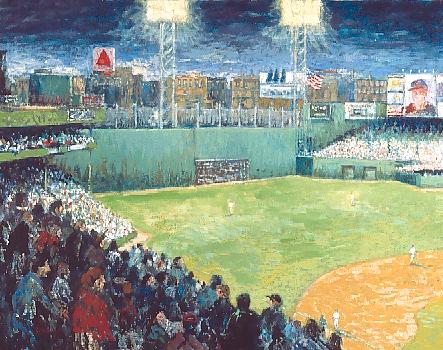
"Standing Room Only" by Loretta Feeney is now available as a limited edition print.
For more info on this and other Fenway artwork, click here.
|
Concerts at Fenway Park |
| Sept. 6 & 7, 2003 | | Bruce Springsteen and the E Street Band |
| Sept. 10 & 12, 2004 | | Jimmy Buffett and the Coral Reefer Band |
| Aug. 23 & 26, 2005 | | The Rolling Stones |
| July 7 & 8, 2006 | | Dave Matthews Band |
| July 28 & 29, 2007 | | The Police |
| Aug. 23, 2008 | | Neil Diamond |
| May 29 & 30, 2009 | | Dave Matthews Band |
| May 31, 2009 | | Phish |
| Aug. 5, 2009 | | Paul McCartney |
| Aug. 13 & 14, 2010 | | Aerosmith & J. Geils Band |
| June 11 &12, 2011 | | New Kids on the Block & Backstreet Boys |
| Sept. 8 & 9, 2011 | | Dropkick Murphys & Mighty Mighty Bosstones |
| July 1, 2012 | | Roger Waters: The Wall |
| Aug. 14 & 15, 2012 | | Bruce Springsteen and the E Street Band |
|

A display of pictures from Fenway Park conerts is on the Pavilion level on the third base side.
 Find us on facebook Find us on facebook
|